Black Eyes

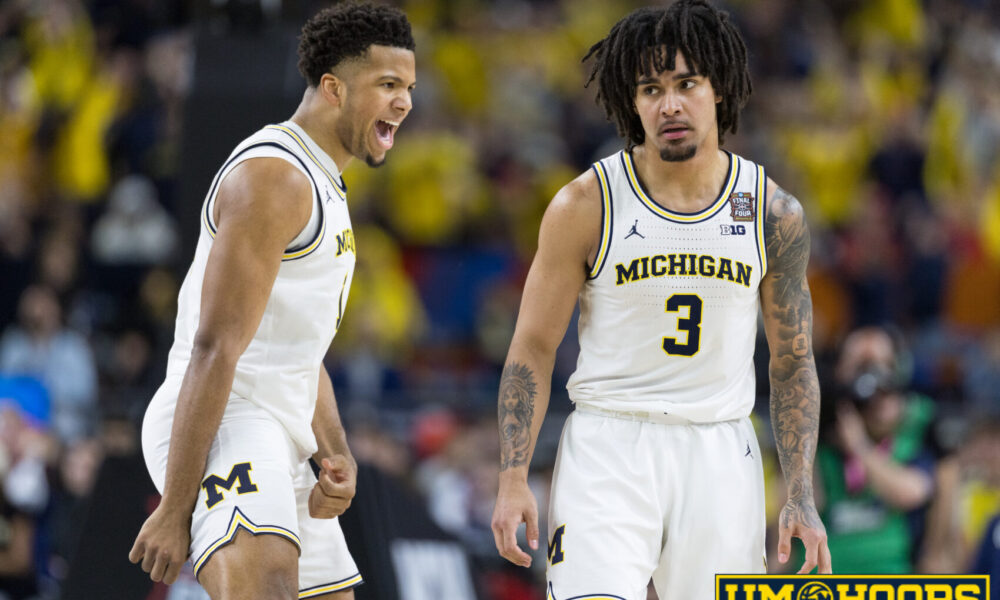
It’s easy to remember the exciting parts of last season. Whether it is the early season win over UCLA or rushing the court after the Duke game. Maybe finally winning a big road game at Minnesota or the NCAA tournament win over Clemson. Last season was a breath of unexpected fresh air that caught most Michigan fans off guard.

Now, expectations are real: this is an NCAA tournament team. Michigan has typically fallen in the 10-20 range in most pre-season polls and success is expected.

All signs point to a successful season this year but let’s play devil’s advocate for a bit now and take a look at five of Michigan’s not so glorious moments. It’s important to remember that although they made their first NCAA tournament appearance in a decade, Michigan was a couple bounces (versus Savannah State or Indiana for example) away from the NIT.

No team looks great every time they take the floor, but these five games stand out as the worst performances by Michigan last year and reminders that there is still a ways to go.

[click to continue…]

Tuesday Links

Some updates from around the conference:

Preseason Three Point Analysis

stu-douglass-three llp-three novak-three

Like it or not, John Beilein’s basketball teams are perimeter oriented teams. Beilein has a model and, besides a few tweaks here and there, he is comfortable sticking to it because it works. The ideology behind a POT is that you shoot a lot of threes while sacrificing offensive rebounding for not turning the ball over; the catch is that you have to make your threes.

While Michigan’s statistical profile last year was a lot closer to the West Virginia Beilein model than the year before, it still wasn’t quite there. The main issue was Michigan’s team three point shooting percentage of 33.4% (32.1% in conference).

Luke Winn points out that Michigan doesn’t return any one who made over 34.5% of their three point shots while Beilein’s best team at West Virginia returned 6 players that topped that mark.

Basically Michigan managed to win a lot of games last year despite being a perimeter oriented team who can’t make threes – the cardinal sin. To repeat that success, or improve upon last year, they are going to have to make more of their threes if when they shoot so many.

To put this in perspective, I put together a scatter plot of 3PA/FGA (how many threes a team takes) versus 3pt field goal percentage.

image

(The Big Ten teams are all listed with conference-only numbers, while Beilein’s WVU teams are from their entire season.)

The axes are aligned at conference averages (35% 3PFG%, 37% 3PA/FGA) which leaves us with four quadrants.

  • Bottom left: teams who shoot few three pointers and make them at a below average rate.
  • Top left: teams who shoot a lot of three pointers and make them at a below average rate.
  • Top right: teams who shoot a lot of three pointers and make them at an above average rate.
  • Bottom right: teams who shoot few three pointers but make them at an above average rate.

[click to continue…]

Open Scrimmage Thoughts

Today’s open practice began with lots of skill work including stations with 3-4 man groups simulating game situations. After that, there was some full court fast break drills and some controlled scrimmage. Finally, they went into a full scrimmage for about 35 minutes with a running clock. The season is almost here with the first exhibition game only two weeks away.

Here are some quick thoughts on a player-by-player basis, although I’d be hesitant to take too much from one practice.

  • The “starting lineups” in the scrimmage were: Darius Morris, Matt Vogrich, Zack Novak, DeShawn Sims, and Ben Cronin versus Laval Lucas-Perry, Stu Douglass, Eso Akunne, Anthony Wright, and Zack Gibson. The offensive play was a bit sloppy but they have only been practicing for a week now and are working plenty of freshmen into the system.
  • Manny Harris was nursing a hamstring injury and didn’t participate in the full court scrimmage. I think this is just a case of being as careful as possible with your star player. He worked on his jump-shot off to the side and it looked as smooth as ever.
  • Stu Douglass probably has a better grasp on the offense than Laval Lucas-Perry and Darius Morris but the problem is that he is significantly better playing shooting guard. I think you get the most of Stu Douglass by allowing him to play in his more natural point guard spot off the ball.
  • Zack Novak is just fun to watch and he didn’t disappoint. Novak does everything on the floor and is also one of the more vocal players on the team. During the scrimmage, Novak scored a variety of backdoor cuts and three pointers while also being quick to jump on the ground for loose balls. Novak played a ton of minutes last year for a reason, I have a hard time envisioning a situation where his playing time decreases dramatically.
  • Darius Morris looked comfortable playing the point guard but he’s going to have to realize that this isn’t high school anymore. He has to be judicious when driving into the lane and also make smarter passes at times. On the other hand, he probably has the best handle on the team and will be able to help this team. Judging by the way Beilein was quoted, it looks like Darius might be very close to locking up the point guard spot: “It’s going to be interesting. Darius Morris has made an impression already. He’s got great quickness. He’s learning. He wants to play defense, which is really important as we know at that position. And Stu (Douglass) and Laval (Lucas-Perry) — it’s which one would be the point guard if Darius wasn’t the point guard.”
  • Ben Cronin is big but he’s going to have to get faster, both mentally and physically. His size will probably get him onto the court but his presence forces Michigan to change their approach a bit.
  • DeShawn Sims seemed content to settle for jumpers, mainly from three point range. This was probably a product of playing alongside Cronin at times but I think we need to see healthy doses of DeShawn Sims on the block this year.
  • Zack Gibson has some skills but the question is what he can bring to the table consistently. He has always shown flashes, most recently with some strong play in the NCAA tournament, but he also tends to disappear for weeks. Today, his jumpshot wasn’t falling at all.
  • Anthony Wright another streak shooter but he was feeling it. Wright hit several triples in the scrimmage that helped get his team back in the game.
  • Blake McLimans has a nice stroke and good size for the four position but he has a long ways to go on defense. His length gives him the potential to be a good defender but he looked pretty lost off the ball. McLimans also didn’t show much during the scrimmage. He has the proper size and skillset to be a contributor at the four but he’s not there yet.
  • Matt Vogrich‘s shot is pure and he’ll definitely play this year.
  • Laval Lucas-Perry was solid but didn’t really stand out but he still looks significantly leaner and quicker than a year ago.
  • Eso Akunne will bring a unique skill-set but I wouldn’t bet on him being a contributor at this point. His shot needs a lot of work before I think he can be a consistent contributor.
  • Jordan Morgan spent most of the day shooting jumpers off to the side but it appears that he progressing.
  • Trey Zeigler and Evan Smotrycz were in attendance at the practice for a while.

Friday Links

On Harris v. Lucas

harris-lucas

Without saying a word this site has ended up in the middle of a debate: who’s the better point guard, Michigan State’s Kalin Lucas or Michigan’s Manny Harris.

John Gasaway started the debate on this very site with this comment on Manny Harris:

In fact, I want to pipe up on behalf of one of your players. I read the interview you did with KJ of The Only Colors and I have to take issue with your statement that Michigan State’s Kalin Lucas “is easily the best point guard in the conference.” Really? What about a certain Manny Harris? Oh, I know last year there were always other Wolverines on the floor alongside Harris who proudly wore the “point guard” label (Kelvin Grady, C.J. Lee, Stu Douglass, etc.). I for one don’t buy it. Harris had by far the highest assist rate on the team and, more importantly, he ran this offense in the literal Beilein-ian sense. Plus Lucas is hapless inside the arc, making an anemic 40 percent of his twos last year. I’ll grant you that Lucas made Sherron Collins look really bad at a propitious moment (less than a minute left in a tie game) in the Sweet 16 and is clearly superior to Harris when it comes to nailing threes. I’m just sayin’. Not open and shut from my chair.

KJ ran the numbers to try to determine a winner. Looking at only conference numbers, KJ concludes that Lucas has the advantage in the point guard battle because he turns the ball over less and shot much better from three point range. The other two stats that KJ looked at were assist and free throw rates, which turned out to be roughly equivalent.

The most interesting point that KJ makes is that Kalin Lucas morphs into whatever Michigan State needs him to be based on the opponent:

Against non-Big Ten foes, Lucas fits the mold of the traditional pass-first point guard.  He distributes the ball to his teammates, minimizes turnovers, and scores at a relatively modest rate.  And it isn’t just a case of padding the ball-handling stats against weaker opposition; the numbers don’t change much if you restrict the sample to nonconference opponents from BCS conferences.

Against Big Ten adversaries, meanwhile, Lucas morphs into a shoot-first point guard.  The assist number drops substantially, with an uptick in turnovers, and the scoring average shows an offsetting increase.

Let me state my theory on Lucas in broader (and less emotionally-detached) terms : Kalin Lucas does what his team needs him to do to win games.  Against faster-paced opponents, he runs the fast break with superb efficiency.  Against more plodding opponents, he finds ways to score in the half-court offense.

I think the moral of the story is that Kalin Lucas and Manny Harris are very different players who somehow come away with similar stat lines because of the role each plays for his team.

Lucas is a pure point guard in every sense of the phrase. Luckily for him, he plays in an offense that relies on a guy like him to control the ball and make plays in the half court offense. When MSU runs, he is able to shift gears and turn into a pass first player, distributing the ball to MSU’s stable of wings in transition.

Michigan, on the other hand, runs a two guard offense that was designed to eliminate the need for a true point guard. Beilein’s offense revolves around spacing and doesn’t call for one player to dominate the ball in the half court set. Manny Harris does a little bit of everything for Michigan but it prevents him from falling into any traditional role. He plays the three but distributes like a point guard, scores like a wing, and attacks the defensive glass like a big man.

I concede that Kalin Lucas is a better point guard than Manny Harris, especially in Big Ten play when Lucas snapped out of his early season funk. But I think the most impressive point here is that Manny had a higher assist rate in conference play than one of the top point guards in the country. Not to mention that Harris’ defensive rebounding percentage in conference games was in the same league as Big10 rebounding elites such as Joe Krabbenhoft, Mike Davis, and Paul Carter.

The obvious argument against Harris’ remarkable statistical well-roundedness is that he is forced to do everything as a product of his teams’ flaws. For example, Brian Cook points out that his rebounding is merely a function of being the second tallest player on his team. Maybe so, but I have a hard time believing that Harris wouldn’t be a tremendous defensive rebounder for any school in the country.

Page 497 of 615« First...495496497498499...Last »