Archive for the '2008-2009 Season' Category

Play of the Year 2008-09

Credit goes to the commenters on this one, the UMHoops 2008-2009 Play of the Year Voting. There are ten nominees, I was originally going to keep out longer stretches but I threw them in there anyways. I guess this is more or less a “moment of the year” rather than a specific play.

The nominees are sorted in chronological order and you can vote at the bottom of the post.

Stu Douglass Three Pointer versus UCLA

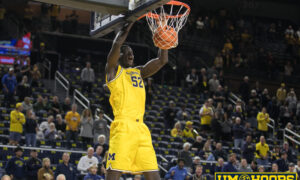
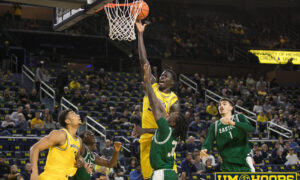
DeShawn Sims Backdoor Dunk versus UCLA

DeShawn Sims Buzzer Beater versus Savannah State

Zack Novak Back-to-Back Threes versus Duke

Manny Harris ‘Airplane Dunk’ versus Duke

CJ Lee and Laval Lucas-Perry Save Michigan Down the Stretch at Assembly Hall

Stu Douglass Steal and Over the Head Pass versus Purdue

Laval Lucas-Perry Three Point Barrage at Minnesota

DeShawn Sims Scores First Seven Baskets vs. Iowa

Manny Harris “And One” versus Clemson

Vote

What was the play of the year?

  • Harris 'and one' vs. Clemson (34.0%, 284 Votes)
  • Sims backdoor dunk vs. UCLA (33.0%, 281 Votes)
  • Laval Lucas-Perry Three Point Barrage at Minnesota (8.0%, 65 Votes)
  • Novak back-to-back threes vs. Duke (6.0%, 54 Votes)
  • Harris 'air plane' dunk vs. Duke (6.0%, 54 Votes)
  • Douglass three pointer vs. UCLA (3.0%, 25 Votes)
  • Lee and LLP save U-M in in Bloomington (3.0%, 21 Votes)
  • Sims buzzer beater vs. SSU (2.0%, 20 Votes)
  • Stu steal and over the head pass (2.0%, 18 Votes)
  • Sims scores first seven baskets vs. Iowa (2.0%, 17 Votes)

Total Voters: 839

Loading ... Loading ...
44 Comments

Report Card: DeShawn Sims

Previously: Stu Douglass (B-), Zack Novak (B), Laval Lucas-Perry (C), Manny Harris (A)

Michigan Northwestern Basketball

O Rtg Usage MPG PPG RPG FG% eFG% 3PT%
106.9 31.8% 30.7 16.9 6.8 50.5% 53.3% 31.7%

The Good

  • Scoring
    DeShawn showed us that he really is the scorer that he was recruited to be. His freshman year was wrecked by family tragedy and his sophomore year saw him live almost exclusively on the perimeter. This year he was forced to the paint — more so  by necessity than choice. Luckily, DeShawn was up to the challenge. He attempted 60 less three pointers this year, but managed to lead the Big Ten in field goals made while making 224 of his 444 attempts (50.5%, 53.3 eFG%).
  • Rebounding
    Because he was forced to play down low, it was crucial that Sims attack the glass. Sims averaged 6.8 rpg (5th in conference) and was tied with Manny Harris for the leading rebounder on the team. He struggled at times in conference play on the glass and his average steadily declined but that was mostly a product of dealing with better rebounding teams in the Big Ten.
  • Improvement
    Peedi improved in just about every facet of the game. This should be expected I suppose but as we saw under Tommy Amaker, improvement should never be taken for granted. Even beyond the numbers, Sims looks more confident within the offense and he continues to find his niche.

The Bad

  • Consistency
    Sims eliminated the Georgetown-esque 1 point performances that we saw in his sophomore year but he still struggled to bring a consistent effort night in and night out. Part of the problem is that his play was so spectacular at times  that you wonder why he wasn’t able to do it every time out.
  • Drifting
    All too often Sims would drift to the perimeter instead of focusing his offense in the interior. It is critical that Sims plays inside out. He has to start inside where he can build his confidence before he starts launching longer jumpers.

Shining Moments

  • vs. Duke – 28 points (10-16 shooting), 12 rebounds, 3 assists, 1 steal
    The Duke game was the defining moment of Michigan’s season and DeShawn Sims was the star. DeShawn scored the ball inside and out while controlling the glass despite being a non-factor in the first Duke/Michigan match-up that took place only a couple weeks earlier.
  • vs. Purdue - 29 points (13-16 shooting), 5 rebounds
    Another glimpse of just how dominant DeShawn can be. He took the ball right at JaJuan Johnson, who was eventually forced to the bench with foul trouble, and scored inside all night long. This one was an absolute must-win for Michigan’s tournament chances and DeShawn came to play.
  • vs. Iowa – 27 points (12-16 shooting), 2 rebounds, 3 steals
    DeShawn Sims single handily punched Michigan’s NCAA tournament ticket. Michigan went to Sims early and often and just sat back and watched as he made his first eight shots from the field and simply couldn’t be stopped.

The Future

DeShawn has played a dramatically different role in each of his three seasons at Michigan. His freshman year he was a seldom used back-up power forward. His sophomore year he played the “four” in Beilein’s offense which saw him floating around on the perimeter and launching three point shots. And finally, this year he played the “five” where he was almost exclusively an interior player.

The question is where does he go next year? There is a much larger stable of interior players next year but I’m not sure any of them have the ability to score in the post the way DeShawn does. I think we will most likely see a mix of DeShawn at the four and five. Against bigger lineups we will see him play the four along side someone like Ben Cronin while against smaller lineups we will see him down low in hopes that he can exploit a mis-match.

Final Grade: A

DeShawn deserves nothing but an ‘A’. Politics may have forced him off of the All-conference first team, but statistically he had a spectacular season. He was a top five scorer and rebounder and posted an effective field goal percentage of 53.3%. Not to mention the fact that he did all of this while playing down low in arguably the most physical conference in the nation at only 6-foot-8.

Did he have some disappointing performances? Definitely, but over the course of a season, who doesn’t? The improvement that he made in between each of his three years at Michigan has been remarkable. If he can make similar strides before his senior year we should be expecting another special year.

21 Comments

Award Night


The basketball banquet was tonight and there weren’t many surprises in terms of who brought home hardware.

Manny Harris took down his second MVP award (guess he was deserving of the ‘A’ I gave him on his report card) and DeShawn Sims won most improved player. Good luck finding anyone to argue with the leadership award being given to CJ Lee and David Merritt. Frankly, there isn’t much to argue over with any of the winners.

According to the Michigan basketball twitter page, every player on the team also received a “special watch” in honor of making the NCAA tournament. They are tweeting live from the event so it’s worth a follow.

Here is the full list of award winners:

Bill Buntin Most Valuable Player Manny Harris
Thad Garner Leadership Award C.J. Lee and David Merritt
Rudy Tomjanovich Most Improved Player DeShawn Sims
Steve Grote Hustle Award David Merritt
Travis Conlan Sportsmanship Award Jevohn Shepherd
Wayman Britt Outstanding Defensive Player C.J. Lee
Sixth Man Award Zack Gibson
Iron Man Award Zack Novak
Bodnar Award for Academic Achievement Zack Novak
Gary Grant Award for Most Assists Manny Harris
Loy Vaught Rebounding Award DeShawn Sims
Award for Outstanding Free Throw Shooting Manny Harris
16 Comments

Report Card: Zack Novak

Previously: Stu Douglass (B-)

Zack Novak


O Rtg Usage MPG PPG RPG APG eFG% 3PT%
106.0 14.0% 28.7 6.7 3.5 1.4 50.5% 34.4%

The Good

  • Shooting
    Zack can definitely shoot the three and he hit enough big shots this year to prove it. Zack shot the ball well at the beginning of the year and then hit a wall through the middle of January. The Big Ten season clearly wore him down but he bounced back well down the stretch. Zack loves the corner three and when he’s open he’s a good bet to knock it down. I don’t think he is quite as good at creating a good look for himself as someone like Stu Douglass but he did shoot a higher percentage than Stu.
  • Hustle Plays
    It’s hard to quantify something like this but there is no denying that Zack has a nose for the basketball. It seemed like Zack was always the first one to a 50-50 ball or would manage to tip out a rebound despite giving up half a foot to the opponent. These hustle plays are the reason that Zack led the team in minutes per game during conference play (13th in the conference, 2nd highest average for a freshman) and continues to see the floor despite match-up problems.
  • Mental Toughness
    This is a bit hard to distinguish from the hustle plays but Zack was tough. He had the attitude that he wasn’t going to take crap from anyone and he was going to leave it all on the floor. He begged to go back in the game after Alex Legion bloodied him and he was a key cog in both of Michigan’s miracle comebacks. Not to mention the fact that most 6-foot-4 freshmen don’t play 30+ minutes per game in the most physical conference in the country at the power forward spot. Zack has the attitude that the coaching staff loves and I have no doubt that he will become a leader on this team.

The Bad

  • Versatility
    Similar to Stu Douglass, Zack needs to add a few more elements to his game. Right now on the offensive end he isn’t much more than a spot up shooter. Zack showed flashes of a little bit of mid-range game here and there but it really isn’t in his repertoire. He doesn’t need to be Manny Harris but if he can do just a little more he will be much more dangerous.
  • Physical Ability
    It’s hard to point to negatives on the production side when you look at Zack. He basically did about everything that you could expect. The bottom line is that his ceiling is limited by his height and athleticism. If he was a little taller, faster, or quicker you would have a completely different player. Instead he is stuck at 6-foot-5 — hopefully with some work in the S&C program he can continue to improve athletically.
  • Position
    Zack can probably play the 2, 3, or 4 on this team but he probably isn’t a good fit for any of them. The mantra goes: you are what you can guard. Right now I’m not sure Zack can guard any of those positions that well. He’s too short to guard the four and probably too slow to guard the two or three. This is going to be the biggest problem for Zack going forward — where does he play?

Shining Moments

  • vs. Duke – 14 points, 26 minutes, 4-7 3pt FG
    This was Zack’s coming out party with four three point makes on the biggest stage. The most important shots were the back-to-back threes that turned a three point deficit into a lead that Michigan would never relinquish. DeShawn Sims and Manny Harris carried the team that day but Zack Novak gave them the lift that pushed them over the top.
  • vs. Minnesota – 36 minutes, 18 points, 6 rebounds, 6-10 3pt fg, and 2 assists
    Michigan was in a familiar position, their backs were up against the wall and Minnesota was headed to Ann Arbor. A loss would have ended likely Michigan’s NCAA tournament chances and Minnesota was no slouch. Zack came to play and knocked down a season high six three point shots for a game high 18 points in a smooth Michigan win.

The Future

Where does Zack play down the line? I would assume that he will get some minutes backing up Manny next year at the three, 5-10 minutes per game. I would also assume that he still plays some four, especially against smaller teams, maybe 15 minutes per game. There is also the chance that Zack could play the two-guard where he played for the first half of last year. Essentially his versatility in terms of position is his greatest strength as well as his greatest weakness.

Zack seems unlikely to play 30+ minutes per game next year but I just have a hard time picturing the coaches keeping him off the floor. I don’t care what influx of talent Beilein brings in, it will be hard to knock Zack out of the starting line up and at least the rotation. It seems like there is always a spot for hustle, heart, and shooting in the John Beilein system.

Final Grade

Some people were a little surprised that I only gave Stu a B- but I think when everything plays out it will make sense. I don’t want to be accused of grade inflation and while I mentioned expectations in the first post but it’s more or less a comprehensive measure and expectations are just one part.

Final Grade: B. Even though he didn’t produce in the scoring column every night I don’t think this team wins nearly as many games without him in the lineup. Zack essentially was expected to be a spot contributor at best and by the end of the year you couldn’t pull him off the court.

33 Comments

Report Card: Stu Douglass

Stuart Douglass

The Numbers:

O Rtg Usage MPG PPG RPG APG eFG% 3PT%
98.6 17.4% 22.7 6.1 1.4 2.1 50.2% 33.5%

The Good:

  • Passing
    Stu is vastly underrated as a passer. From the first time I saw him play in the Michigan jersey I was impressed with how confident he was with the ball, especially passing it. I also think that Stu is the best player on the team at feeding the post. The numbers back Stu up as a good, not great passer. His assist to turnover ratio was 1.7 to 1, 16th in the Big Ten, but his assist numbers weren’t quite so high with 2.1 assists per game but that translates out to 4 assists per 40 minutes, the same as Grady and Lee, and his assist percentage of 19.3% is also in the same ballpark as Michigan’s point guards. Stu definitely has room to grow in this regard but he definitely displayed the ability to pass the ball.
  • Three Point Shooting
    The percentage isn’t necessarily gaudy at 33.5% but it’s not bad either. In the “hot” games he turned everyone into believers with his quick and pure stroke. The shot looks good all the time and I wouldn’t be surprised to see a big jump in Stu’s shooting percentage next year.
  • Defense
    If I wrote this mid-way through the season I probably would have listed defense as a weakness. Stu improved by leaps and bounds on the defensive end of the court over the course of the year. He still has a long ways to go as an on-the-ball defender but he is one of the best in terms of fighting through screens and playing defense off the ball.

The Bad:

  • Consistency
    Stu showed flashes of brilliance shooting the ball but really struggled with consistency. A lot of this has to do with being a freshman and being asked to do a lot from the get-go, as well as his role changing pretty dramatically a couple times throughout the season. Stu had 10 games without a three pointer, 10 with only one, and 15 with two or more.  This is a little bit too inconsistent in my book, if Stu could cut down on the 0-5, 1-7, 1-5 type games he could be very solid.
  • Versatility
    Stu made two baskets and four free throws in the ten games where he didn’t record a three point field goal. He needs to develop at least one more key cog to his game whether it is a mid-range jump shot or the ability to drive the lane and maybe get to the lane. Adding another dimension to his game has to be the number one priority for Stu because when the three point shot wasn’t falling last year, Stu was very ineffective.
  • Decision Making
    Stu clearly has ability to pass and shoot but he still needs to learn what is a good shot and what is a good pass. The alley-oops, three point shots from 6 feet behind the line, and bounce passes between three people need to stop. I give him a break because he is a freshman but if Beilein’s facial expressions say anything about how he really feels, you can bet that he let’s Stu know what’s a good decision.

The Future:

Point guard. There are a growing number of options at the two-guard on this roster and if Stu wants to keep playing big minutes he’s going to need to play the point. He’s not going to be a full time point guard but he needs to be able to play the position for 10-15 minutes per game. I think you definitely still want to play him at the two because that allows him to come off screens and get good looks from three point range. However Laval Lucas-Perry, Zack Novak, and Matt Vogrich will all be vying for playing time at the two-guard so being able to play two positions would be a great way for Stu to differentiate himself from the pack.

Grade: I’ve been struggling with figuring out a means to “grade” players in these report cards. I have basically two sides: grading versus expectation versus some kind of all-encompassing grade of production.

There were essentially zero expectations for Stu headed into the year. He was supposed to be a shooter but likely a ways off from being a contributor — after all he was just a 2-star recruit when he committed to Michigan. Stu also hit some huge shots this year, UConn and UCLA stand out, and his confidence continued to grow over the course of the year. Stu slipped out of the starting lineup in January but I really think that he started to believe that he belonged as the year progressed.

B-. Stu showed that he has the ability to fit into this team and showed flashes of great play but the lack of consistency and versatility are holding him back.

25 Comments